At the Well, Moulin Huet: A Moment of Ordinary Life in Rural Guernsey
The photograph appears unremarkable at first glance: three young women, a stone well, a farmhouse behind them, and a dirt track winding away through trees. No drama. No ceremony. And yet it is precisely this ordinariness that makes the scene so valuable.
This image was taken at Moulin Huet, likely in the late 19th or very early 20th century, a period when photography had begun to venture beyond studios and into everyday rural life. Moulin Huet, now best known for its dramatic bay and artistic associations, was at that time a working valley — a place of farms, wells, footpaths, and labour carried out largely by hand.
The Setting
The stone well in the foreground is entirely typical of Guernsey’s rural infrastructure before widespread piped water. Many valleys relied on communal or semi-communal wells, often positioned near farmhouses or along shared paths. Water had to be drawn daily — for drinking, cooking, washing, and animals — a task that fell most often to women and girls.
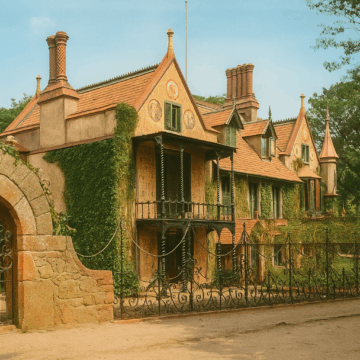
The farmhouse behind them, built of local granite and roofed with slate, fits squarely within Guernsey vernacular architecture of the period. The climbing greenery on the walls was not decorative but practical: ivy and other plants helped regulate temperature and protect stonework from weather.
The path behind the well leads deeper into the valley. The small group of figures in the distance are likely neighbours or family members — perhaps returning from church, a nearby holding, or simply passing through on foot. In rural Guernsey, walking was the default mode of transport.
The People

The women’s clothing provides some of the strongest clues to date and context. Their long skirts, high collars, and practical aprons suggest working attire rather than formal dress. Straw hats, common among rural women, offered protection from both sun and drizzle and were widely worn from the 1880s into the early 1900s.
One woman holds a metal bucket — a relatively modern item compared to earlier wooden or ceramic containers. Galvanised metal buckets became more common toward the end of the 19th century, supporting a late-Victorian or Edwardian timeframe.
Their expressions are serious but not posed in a theatrical sense. Early photography required stillness, and the neutrality of their faces reflects the practical nature of the moment. This was not a special occasion. This was simply part of the day.
Daily Life at Moulin Huet
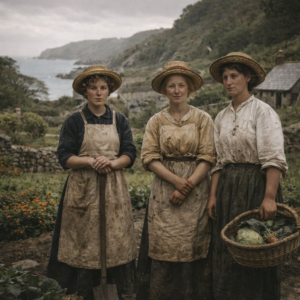
At the time this image was captured, Moulin Huet was not a destination; it was a place people lived and worked. Farming dominated the valley, with small mixed holdings producing vegetables, dairy, and flowers — Guernsey’s agricultural economy already beginning to lean toward export.
Women’s work was constant and essential. Drawing water, managing households, assisting with farm tasks, and caring for extended families were all part of daily routine. Life followed the rhythms of daylight, weather, and seasons rather than clocks.
Photography itself was still a novelty in rural settings. The presence of a camera suggests either a visiting photographer or a local resident with access to equipment — perhaps documenting rural life, perhaps simply experimenting with a new technology.
Why This Moment Matters
Images like this matter not because they show famous people or historic events, but because they preserve the texture of ordinary life. They remind us that Guernsey’s history is not only forts, governors, and wars, but also wells, buckets, paths, and people pausing briefly as the future clicks into focus.
At Moulin Huet, long before artists arrived with easels and visitors came with cameras of their own, people lived, worked, and carried water from stone wells — one bucket at a time.
And for a fraction of a second, that ordinary labour became permanent.
Discover more from Guernsey Deep Dive
Subscribe to get the latest posts sent to your email.